Why Doesn't Mormon Apologist Use
The Book of Mormon
To explain Who God Is?
No Roots?
No Church...
www.RestoredGospel.com/teach/Roots.pdf Page 1 of 9 February 2026
The Underappreciated Roots: Covenants in the Olive Tree Allegory
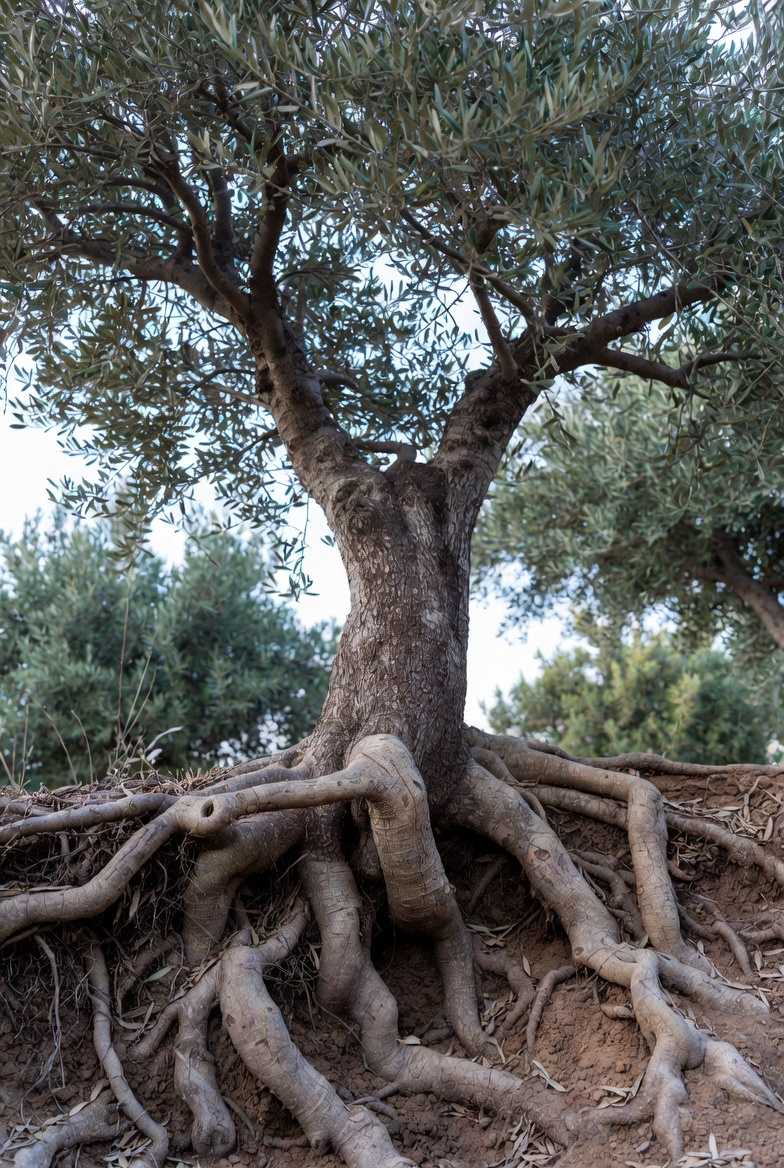
The under-appreciated element of the Olive Tree story are the Roots.
The allegory of the olive tree in Jacob (RCE Jacob 3/LDS Jacob 5) is one of the Book of Mormon's most vivid extended metaphors.
Its major symbols are straightforward from the text.
- The tame olive tree is explicitly the house of Israel
- Its branches represent portions of that house, scattered into the nethermost parts of the vineyard (the world).
- The wild olive tree signifies the Gentiles.
- Grafting and pruning depict the scattering and gathering of Israel, and the Lord's ongoing efforts to produce good fruit.
- The fruit itself plainly stands for the righteousness—or corruption—of the people and their response to Christ.
These elements are obvious on a first reading.
Far less noticed, however, are the roots.
The allegory returns to them again and again, always in the same insistent tone.
- When the tree begins to decay, the Lord grafts wild branches in "that perhaps I might preserve the roots thereof that they perish not"
- Later the servant observes that those same wild branches "have nourished the roots, that they are alive and they have not perished"
- The Lord of the vineyard twice declares, "I know that the roots are good, and for mine own purpose I have preserved them" and "that I may preserve the roots also unto mine own self"
- Even when the branches have "overcome the roots" and produced only evil fruit, the roots remain "good" and full of "much strength"
The Lord's final labor is to graft the natural branches back into their mother tree specifically so that the roots may live and ultimately bear good fruit again.
Jacob's own summary confirms the point: God "remembereth the house of Israel, both roots and branches." Since the whole tree is the house of Israel, the branches must represent the people in their scattered and sometimes apostate condition.
What, then, are the roots?
They are the only element that never fails, the only part the Lord refuses to let die, the hidden foundation that gives life to every branch. In the language of the allegory itself, they are the
www.RestoredGospel.com/teach/Roots.pdf Page 2 of 9 February 2026
covenants the Lord made with the house of Israel—those ancient, enduring promises that define Israel as his people and that remain intact even when the visible branches wither or turn wild.
The parable's surface story is dramatic: scattering, grafting, corruption, restoration.
Beneath it lies a quieter, deeper truth. The Lord's work is not ultimately about the branches; it is about preserving the roots—the covenants—so that every branch, natural or wild, may one day draw life from them and bring forth fruit worthy of the vineyard.
The roots have not been well understood because we have been looking at the visible drama above ground. The allegory itself keeps directing our attention downward, to the unseen, unbreakable foundation: the covenants with the house of Israel, which the Lord will never allow to perish.
The allegory in Jacob 5 hammers the point again and again: the roots are good, they have "much strength," and the Lord of the vineyard will do whatever it takes to keep them alive "that they perish not," "for mine own purpose," and "unto myself"
Every other part of the tree—natural branches, wild branches, fruit—can decay, be cut off, burned, or replaced. Only the roots are never allowed to fail.
Jacob's own one-sentence summary immediately afterward makes the identification unmistakable: God "remembereth the house of Israel, both roots and branches."
Since the entire tree is the house of Israel, the branches are the visible, sometimes-faithless people in their scattered condition. The roots, then, must be the unseen, unchanging element that defines and sustains Israel even when the people themselves do not—the covenants the Lord made with their fathers and the prayers of the faithful fathers for their future generations. Abraham's faithfulness, Joseph's diligence, Nephi's pleadings, Jacobs preaching, Omni's assurance his seed will receive the word and one day return to God in covenant. These words and works are the Roots.
But the problem with the Gentiles role…is the rest of the parable.
At first the wild branches produce good fruit. Grafted into the original tree, the wild branches keep the roots alive.
This means that bringing Gentiles into covenant produced faithful witness of Christ, responding in love to fellow man, as guided by the Holy Spirit.
But the Gentiles evolved. Instead of growing in humility, we grew in pride. Church became a place where repentance wasn't preached but prosperity. And if you give more, you will be more easily forgiven of your sins.
The Gentiles grew away from the covenant.
www.RestoredGospel.com/teach/Roots.pdf Page 3 of 9 February 2026
After time, Lord of the vineyard comes down and tastes the fruit of the wild branches. Many kinds of fruit are produced. He tastes of each one. NONE OF THEM ARE GOOD. Here is the exact report from the text:
"And it came to pass that the Lord of the vineyard did taste of the fruit, every sort according to its number. … But behold, this time it hath brought forth much fruit, and there is none of it which is good. And behold, there are all kinds of bad fruit; and it profiteth me nothing, notwithstanding all our labor which we have bestowed upon it."
"All kinds of fruit" — diverse, abundant, impressive in variety — yet none of it is good.
The Lord is grieved; the tree is on the verge of being lost. The servant even reminds him that the wild branches have kept the roots alive but the Lord replies that as long as the tree keeps producing evil fruit, even the roots are of no profit to him. The wild branches have "overcome the roots" and produced "much evil fruit."
In other words, Gentiles were no longer leading people to covenant with Christ, they were leading people in unto their false teachings.
Then comes the turning point.
The only remedy the Lord prescribes is to graft the natural branches back into their own tree and to prune away the wild branches whose fruit is most bitter:
"Let us take of the branches of these which I have planted in the nethermost parts of my vineyard, and let us graft them into the tree from whence they came; and let us pluck from the tree those branches whose fruit is most bitter, and graft in the natural branches of the tree in the stead thereof."
Only after that regrafting does the good fruit finally appear again. As the natural branches begin to "grow and thrive exceedingly," the wild branches are plucked off, and the Lord lays up fruit "like unto the natural fruit" that is acceptable to him.
So the allegory is brutally clear: the Gentiles, left to themselves after being grafted in, produce a bewildering variety of religious expression — but none of it satisfies the Lord of the vineyard. Their fruit is bad. The only path to good fruit is the reconnection of the original covenant people to the original covenants (the roots that were never allowed to die).
That really is a vast departure from what the Gentile world teaches. Almost every Christian tradition today insists that its own system, its own doctrines, its own worship — however diverse — is producing (or at least can produce) the good fruit God wants.
The olive-tree parable says the opposite: those systems, for all their variety and sincerity, are the "all kinds of bad fruit." True, acceptable fruit only reappears when the house of Israel is grafted back into the covenants that have always been the living roots.
www.RestoredGospel.com/teach/Roots.pdf Page 4 of 9 February 2026
The problem is the collective Restoration church (RLDS, LDS, Restoration groups, etc) always exclude themselves from judgment, not recognizing 'we' are included in 'the Gentiles' to whom the Book of Mormon refers. Which means our fruit is also lacking.
Every Gentile church seems to teach its way is the way to true salvation. Expounding rapture theories about how 'the saved' are taken from the earth, or restoration conjecture that Enoch City returns and Jackson county is saved. These all espouse spiritual confidence, but in the end none produce God's desired fruit. They insist their method leads to salvation, but in the end, none of them produce it.
A Sobering reality: The parable never teaches that the unacceptable wild fruit returns to righteousness. Instead, the old solution removes the wild branches.
In the end, it is ONLY when the roots (covenants) and the natural branches (descendants of House of Israel and repentant Gentiles) join together is what finally bear the fruit the Lord has been seeking all along.
As soon as the natural branches are grafted back in and begin to "grow and thrive exceedingly," the process of removal begins:
"and the wild branches began to be plucked off and to be cast away"
The Lord gives explicit, repeated instructions on how this pruning is to be done:
- Pluck only the most bitter first, then progressively clear away the rest "according as the good shall grow"
- "clear away the bad according as the good shall grow, that the root and the top may be equal in strength, until the good shall overcome the bad, and the bad be hewn down and cast into the fire"
- "the bad shall be cast away, yea, even out of all the land of my vineyard"
- "until the bad had been cast away out of the vineyard, and the Lord had preserved unto himself that the trees had become again the natural fruit"
The outcome is not a mixture of the two systems. The bad wild branches are removed so completely that the vineyard once again produces only "natural fruit" that is "good and the most precious above all other fruit" , and "the fruits were equal" . The tree becomes "like unto one body" again—Israel, restored to its own roots and covenants.
The Book of Mormon never once describes a scenario in which the Gentiles, left in their scattered, grafted condition, suddenly produce the good fruit on their own. Nor does it ever speak of them being "plucked off the earth" in some pre-tribulation escape while Israel is left to suffer. Instead, when the fulness comes to the remnant of Israel in the latter days, the Gentiles are warned that if they do not repent and join that covenant, they "shall be cut off" and "trodden down."
www.RestoredGospel.com/teach/Roots.pdf Page 5 of 9 February 2026
So yes—the allegory is stark.
True fruit returns only when the house of Israel is reconnected to the covenants (the roots). Historically, this event has not happened yet.
At that moment, the wild branches that have produced "all kinds of bad fruit" are pruned away. The modern Gentile world's confidence that its own churches, doctrines, and worship forms are already producing (or will produce) the acceptable fruit is simply not the story the Book of Mormon tells. The text is sobering because it is so clear, and because almost no one is talking about it.
What About Enoch?
The restoration churches more or less, hold to an idea that an ancient man named Enoch preserved a city on earth, taken to heaven, that returns to earth someday. The righteous saints are united with him, and afforded protection in his Golden city.
But the Book of Mormon text itself makes this distinction unmistakably clear:
For being the Fullness of the Gospel, Enoch is never mentioned—not once—in the entire Book of Mormon.
There is no reference to him, no story of his city, no covenant tied to him, and no role assigned to him in the latter days.
What the Book of Mormon does emphasize, repeatedly and explicitly, is the covenant the Lord made with Abraham and, through him, with the house of Israel. These are the covenants repeatedly identified as the living, unbreakable "roots" that will be remembered and fulfilled when the natural branches are grafted back in.
A few direct statements from the text:
- 1 Nephi "our father hath not spoken of our seed alone, but also of all the house of Israel, pointing to the covenant which should be fulfilled in the latter days; which covenant the Lord made to our father Abraham, saying: In thy seed shall all the kindreds of the earth be blessed."
- 3 Nephi "ye are the children of the prophets; and ye are of the house of Israel; and ye are of the covenant which the Father made with your fathers, saying unto Abraham: And in thy seed shall all the kindreds of the earth be blessed."
- 3 Nephi "after that ye were blessed then fulfilleth the Father the covenant which he made with Abraham, saying: In thy seed shall all the kindreds of the earth be blessed."
- 2 Nephi "I covenanted with Abraham that I would remember his seed forever."
www.RestoredGospel.com/teach/Roots.pdf Page 6 of 9 February 2026
The Enoch That Isn't There
The Book of Mormon never mentions Enoch. Not once. If the translated city, the Zion covenant, or the "Enochian" latter-day role were part of the ancient record, the text had multiple natural places to say so—and it never did.
If Enoch story was true, why wasn't it included in likely conversation of the Book of Mormon?
In the first chapters of Ether, Moroni abridges the Jaredite history back to the Tower of Babel. The Lord repeatedly calls the land "choice above all other lands" and promises to preserve it for a righteous people.
This was the ideal moment to recall Enoch's city being taken up as the precedent for how God removes and protects the righteous—but the text says nothing about it. The focus stays strictly post-flood, on the Jaredites' own covenant and the curse that follows disobedience.
Other obvious openings are likewise passed over:
- Lehi and Nephi's sweeping visions of Israel's future (1 Nephi; 2 Nephi) always anchor the covenants in Abraham, never in Enoch.
- Jacob's olive-tree allegory insists the "roots" that must never perish are the covenants with the house of Israel, explicitly linked elsewhere to Abraham (1 Nephi; 3 Nephi).
- Christ's own words in 3 Nephi quote the Abrahamic promise as the covenant to be fulfilled in the latter days.
- The title page declares the book's entire purpose is to teach the remnant of Israel "the covenants of the Lord."
- If Enoch witnessed so many grand things 'from all eternity to all eternity' why was the brother of Jared, (who if you believe Enoch's stories are true, chronologically lived after Enoch) told by God himself that no one had ever seen greater things than him?
The fact that a man named Enoch walked with God is not disputed. It is just all the other words written millennia after his life, turning him into the Indiana Jones of the Old Testament, that is called into question.
The elaborate Enoch narrative—his city translated, a special covenant, hidden knowledge preserved—does not exist in the Hebrew Bible (only the terse Genesis 5:24 line).
Why then did Joseph Smith expound on Enoch?
Joseph was surrounded by Free Masons, his father Joseph Smith Sr and brother Hyrum being the closest masons. Freemasonry was the men's social club of the day. Palmyra had an active lodge. Where was the idea of Enoch fostered in the day? By Freemasons, not churches.
The Freemason literature was full of Enoch:
www.RestoredGospel.com/teach/Roots.pdf Page 7 of 9 February 2026
George Oliver – The Antiquities of Freemasonry (1823)
This is one of the most direct and frequently cited works from the decade. Oliver describes Enoch as practicing Freemasonry, being installed as Grand Master, receiving divine revelations of mysteries, building a subterranean temple with nine porches/vaults on Mount Moriah to preserve secrets, and erecting two pillars (one of marble, one of brass) to safeguard antediluvian knowledge against the Flood. The book treats Enoch as a central figure in Masonic legendary history.
Simon Greenleaf – A Brief Inquiry into the Origin and Principles of Freemasonry (1820)
This work includes a front piece and discussion referencing Enoch in Masonic context (noted in later analyses of early 19th-century Masonic symbolism). It touches on foundational legends, including Enoch's role in preserving ancient wisdom.
Richard Laurence – The Book of Enoch the Prophet (1821, Oxford University Press)
The first English translation of the Ethiopic Book of Enoch (1 Enoch), brought to Europe by Freemason James Bruce in 1773. James Bruce discovered the Kebra Nagast document in Ethiopa, many ideas from it are eerily echoed in the Inspired Version account of Enoch.
Enoch's vivid descriptions were not (ever) found in the first 5 books of Moses (i.e. the early records of the bible) but were later inserted.
The Book 1 Enoch, whose oldest sections were written between roughly 300–200 BCE, with later additions around 100 BCE. It was never accepted into the Jewish canon, was regarded as pseudepigraphal (falsely attributed to Enoch), and was excluded from mainstream Judaism and most Christian Bibles for its late date, its teachings about angels, and its apocalyptic themes that diverged from Mosaic tradition.
The specific version that circulated in Joseph Smith's environment—Enoch building nine underground vaults beneath Mount Moriah to hide the ineffable name and sacred knowledge, erecting two pillars to preserve antediluvian wisdom against the flood—came from 18th- century Masonic legend.
It was introduced by James Anderson in the 1723 Constitutions of the Freemasons and elaborated in the 1738 edition, drawing on earlier high-degree lore. In Masonic symbolism, Enoch became the archetypal preserver of geometry, hidden mysteries, and divine secrets—the exact dramatic, esoteric motif that was floating in the fraternal circles surrounding early 19th- century America.
www.RestoredGospel.com/teach/Roots.pdf Page 8 of 9 February 2026
Why did Joseph Smith Jr include them in personal revelation and (later) the Inspired Version?
Because Joseph Smith Jr. felt inadequate, intimidated by men of knowledge surrounding him. If the Book of Mormon was 'new information' to the world, and Joseph was to promote it, why not all this other 'new information' too? The revelations of Enoch were nearly as new in Joseph Smith's day.
The problem: Per the Book of Commandments, translating the Book of Mormon was Josephs' ONLY Gift. These words were changed later in the Doctrine and Covenants stating 'first gift.'
(Book of Commandments left side, Doctrine and Covenants Right side)
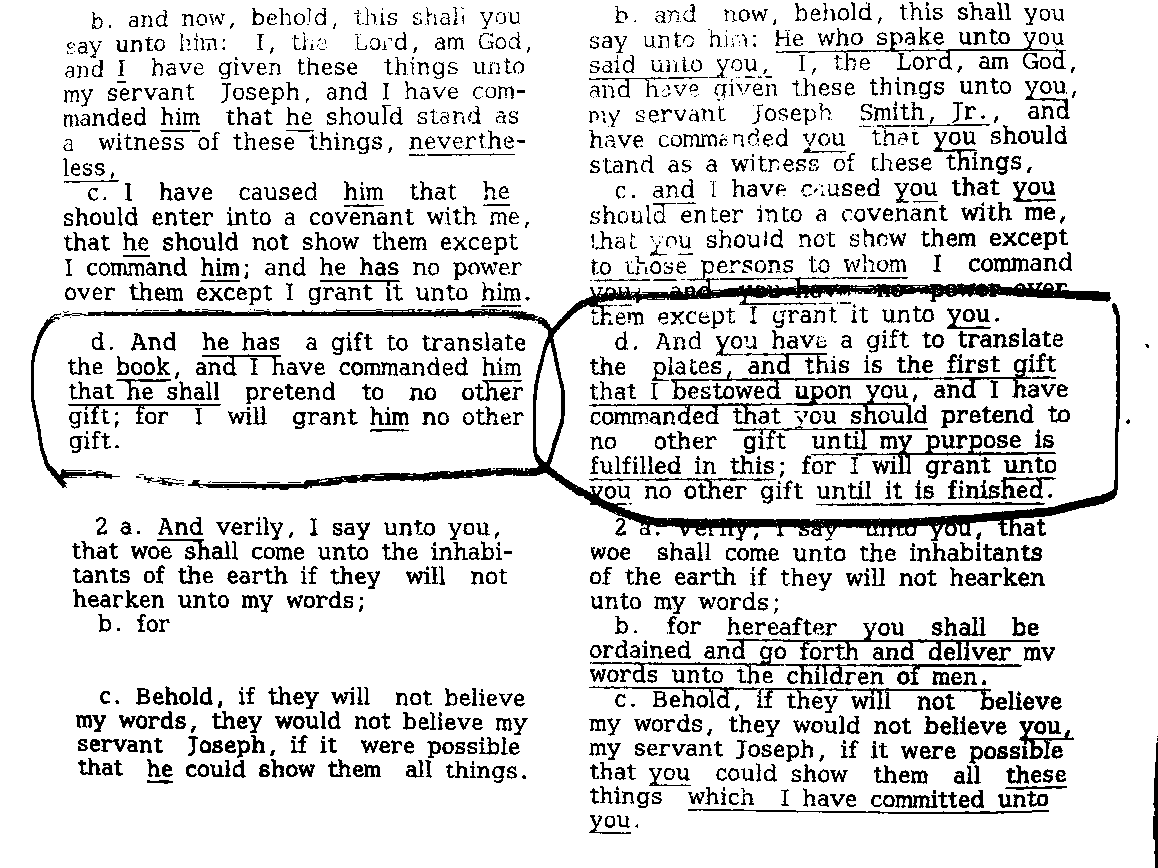
Joseph was not to pretend to any other gift. But yet he apparently did. People had expectations to bring forth revelations, to lead them, to usher in the kingdom, to witness Enoch's city return.
But no. What if none of those tasks were given by God? What if God's sole purpose was to use an uneducated man to translate the perfect ancient record of Joseph's remnant, and nothing else?
What if all these other tasks (which unfortunately failed miserably) were men heaping upon Joseph roles they desired (i.e. give us permission to have polygamy, baptisms for our dead, multiple levels of salvation based on our works).
We have been brought up on an idea of man, a false tradition we accepted from our youth.
www.RestoredGospel.com/teach/Roots.pdf Page 9 of 9 February 2026
Like so many false traditions, stories of Enoch are traditions we were told from our youth. These became staples of religion instead of the Book of Mormon.
The Book of Mormon's complete silence on Enoch is therefore not an accident; it is a boundary line.
The text knows only one set of living roots: the covenants made with Abraham and the house of Israel.
Anything that shifts the latter-day emphasis to an Enochian covenant arrived centuries after the claimed ancient records were written and entered the 19th century through late Jewish pseudepigrapha and Masonic legend—not from the plates. Its absence is the message.
The title page of the Book of Mormon itself declares its whole purpose is
"to show unto the remnant of the house of Israel what great things the Lord hath done for their fathers; and that they may know the covenants of the Lord, that they are not cast off forever."
The text never once suggests that some other covenant (Enoch or otherwise) will be the focus of the last days. It always directs attention back to the Abrahamic covenants with Israel—the same covenants that will cause the wild branches to be pruned away as the good fruit grows (Jacob 5:73–76).
The Book of Mormon is remarkably consistent. Any narrative that shifts the latter-day emphasis away from the Abrahamic covenants and onto something the text itself never mentions is simply not supported by the book that claims to contain the fullness of those covenants. The roots remain what they have always been: the covenants with Abraham and the house of Israel. Everything else in the allegory exists to bring the natural branches back to them.
The roots are the covenants with Abraham and Israel. Everything else—Gentile systems, Enoch fantasies, Restoration add-ons, rapture dreams—ends up on the burn pile when the natural fruit finally shows up. Without the roots life giving essence, there is no religion.
No roots? No church.
Full Stop.